
Product Photography – In-house or Outsource?
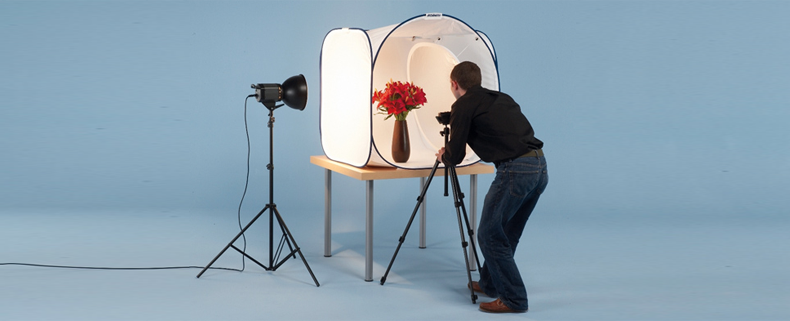
When setting up a web page to sell online, one of the key considerations to make relates to the product photography and whether you should undertake the project in-house or outsource it to a local professional. One of the most common misconceptions about product photography is that it is a relatively quick and simple thing to do. However it can be painstakingly complex and require a huge financial and time commitment.
Here we are going to examine the elements and considerations needed in product photography to help you make the decision whether in-house or outsourcing the project is right for your business.
Location
The term in-house relates to your place of business so the first thing to remember is that you will need the space to set up a studio for the photography. This may not be too much of an issue if you are photographing small items such as bags or kitchenware, but the larger the item the more space you are going to need. That said, if you are looking at outsourcing your photography requirements you will need to speak to your supplier about how they propose to undertake the project. Shipping a bulk quantity of products to a studio can be costly, time-consuming and risky if they are of a fragile nature. Whilst some photographers will arrange the shipping process, just as many will refuse to get involved in that part of the arrangement. When looking for a professional product photographer it is worth asking if any of them have a portable studio they could bring to your place of business, as it would reduce cost and risk.
Size of the project
The size of your product photography project and whether it is a standalone job or likely to be ongoing can be a large indicator as to whether you should outsource the work.
The first consideration to make is the number of images you will need. With most online customers preferring to have photographs that show the product from a variety of angles, you could be looking at providing anything upwards of two or three photographs per product. Multiplying this by the approximate number of products that you have to sell will give you an indication at the overall size of the project.
Once you know the size of the project you then have a number of other decisions to make:
- Is the project large enough or ongoing to warrant purchasing expensive photography equipment?
- Is the project so large that it is going to be too time consuming to allocate your staff to it and away from their normal duties?
Bear in mind at this point that the vast majority of in-house product photographs take substantially longer to do than initially anticipated. If you have a smallish number of items to photograph, or relatively relaxed deadlines, then this may not pose a problem, but if you are waiting for thousands of comprehensive inventory management shots to start selling then outsourcing may be a better option for you.
Staff time and expertise
If product photography is a one-time job then you will likely be redistributing your existing staff to cover the project, however, in doing so you need to consider the impact that this may have on their usual tasks, and the number of distractions that they may experience. The photography project will take considerably longer if staff are needed to complete their usual work, or are regularly distracted by other priorities. Similarly, if the employees that you redistribute to the project are not skilled or experienced in the area in which you have placed them, this will also slow down productivity and may cause errors which are time-consuming to fix. In any business, time is money and if you are going to do your product photography in-house then you need to keep the operation as streamlined and efficient as possible. If product photography is likely to be an ongoing requirement then it may be more beneficial to set up a department of employees specifically for this purpose.
The benefit of outsourcing is that any reputable professional will have high levels of skills and experience, making it easier to keep to deadlines and reducing the likelihood of errors or poor consistency.
Equipment purchases
If you are going to keep your photography in-house you are going to need to make a number of purchases. Alongside photography equipment including a good quality digital camera, light diffuser, lenses and tripod, you will also need a variety of software. Photo-editing software such as Photoshop is a necessity for consistently high quality pictures, and to utilise it effectively you will need a staff member who is skilled and experienced in such programmes. You may also need image production management software, which will give you workflow tools and assist your management, production and quality control systems.This all sounds time-consuming and costly, what benefits can outsource offer me?
Aside from the possible logistical problems associated with an off-site studio, there are a number of benefits to using a professional product photographer. Exact services may vary dependent on the depth of your requirements as many photographers will create a package based upon your needs, but typical services include:
- Collection/return/shipping of products depending on what has been agreed.
- Unpacking, photographing and re-packaging all of your products in accordance with your specifications. During your consultation you will be asked about number of shots per product, creative direction etc.
- Your photographer/his team will then review, edit and format your photographs.
- Your photographer will also undertake quality control of the pictures, although you may wish to step in at this stage and review some or all of the images.
- Finally all the photographs will be delivered to you in accordance with an agreed deadline or timeline.
Whether product photography is a large project or a small one for you, we hope that the information we have provided has given you an indication as to whether in-house or outsourcing will be best for your business.