
Reach your long-term goals with the Eisenhower Matrix
“What is important is seldom urgent and what is urgent is seldom important.”
In his decorated tenures as President of the United Sates and as a five-star General, Dwight D. Eisenhower was a highly accomplished individual. From being named the Supreme Commander of the Allied Forces in Europe during World War II to launching NASA and creating the Interstate Highway System in the United States, Eisenhower’s legacy will forever be etched into history.
However, whilst his achievements say quite a bit about his character, they also explain his ability to work productively, in his chosen professions. This constructive method of organisation, propelled him to manage his daily tasks in a routine that allowed him to complete his long-term goals.
Which is why the aforementioned quote, often ascribed to Eisenhower, has a lasting, and even modern impact, as it asks us to think critically about time management – what is urgent and what is important.
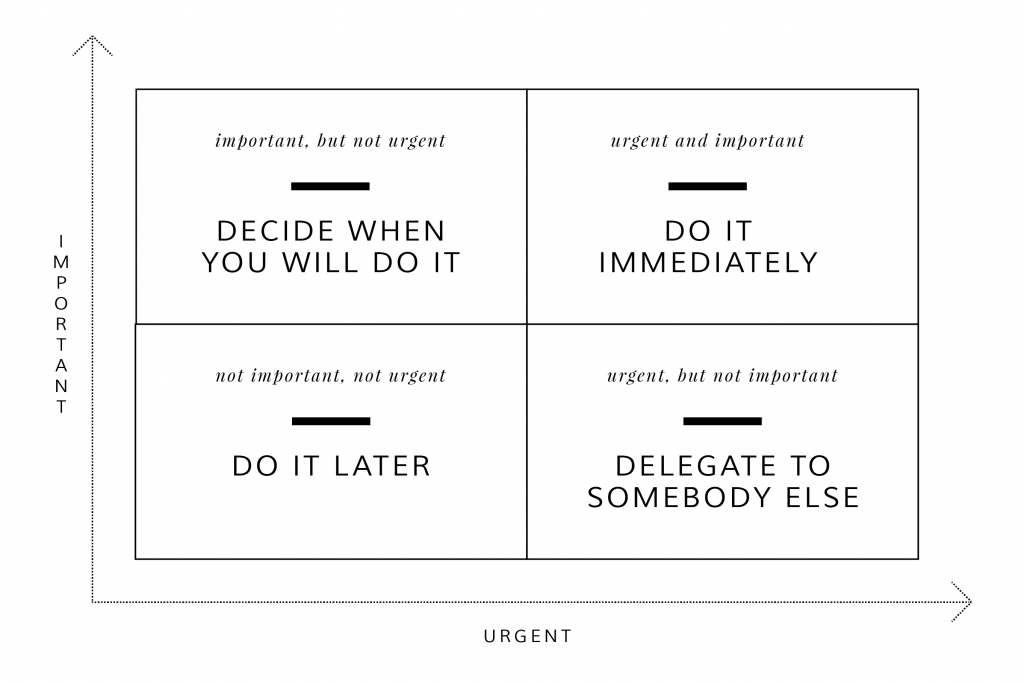
The Eisenhower Matrix was a theory popularized by Eisenhower’s time management and productivity skills, that can enable the user to improve their own effectiveness within the workplace – in pursuit of their desired, long-term goals.
Eisenhower Matrix
| Q1 Urgent & Important Do it immediately | Q2 Important but not Urgent Decide when you will do it |
| Q3 Urgent but not Important Delegate to Somebody Else | Q4 Neither Urgent nor Important Don’t do at all |
The first point to note with Eisenhower’s Matrix is the relationship between urgency and importance. The distinction here, is an important one to make as it basically tells us how we’re supposed to frame the tasks and objectives that we are to complete:
Urgency
Something that requires immediate action. A task to focus narrowly on, without distractions.
Importance
Tasks that work as a stepping stone for a larger goal, within the job, business etc.
As a matrix, the Eisenhower theory is relatively straight forward: A square, split into four quadrants, with each strategy asking us to define tasks by their importance and urgency to better organise our time.
Quadrant 1: Urgent & Important
The first quadrant speaks to the most essential and pressing of tasks. Things you categorise as belonging to the first quadrant are items that should be done immediately, on the same day.
Quadrant 2: Important, but not urgent
The second quadrant refers to tasks that do need to be completed, but not at this very moment. For these tasks, you will be set due dates for when they will be completed.
Quadrant 3: Urgent, but not important
The third quadrant asks you to delegate the items that whilst urgent are not important for you.
Quadrant 4: Neither urgent nor important
The final quadrant simply asks you to get rid of tasks that fill this quadrant, or at least postpone for a late date. These undoubtedly feature more entertainment related tasks.
How to use the Matrix
In the same way a ‘To-Do’ list works, so too does the Eisenhower Matrix. By creating a list of tasks that need to be completed – immediately or otherwise – you can start placing each item into the matrix. As mentioned earlier, it’s important to differentiate between urgency and importance first.
From there, it’s about categorising your task into each of the four quadrants, ultimately to help you focus on what is significant.
To give you an idea of what these tasks might look like, we’ve re-created the Eisenhower Matrix with relevant examples for a business owner:
Q1 Urgent & Important (Do it immediately)
| Q2 Important but not urgent (Decide when you will do it)
|
Q3 Urgent but Not Important (Delegate to Somebody Else)
| Q4 Neither Urgent nor important (Don’t do at all)
|
Getting the most out of the Matrix
At its core, Eisenhower’s Matrix wants to empower people to focus on their long-term goals/vision, by cutting down the menial tasks in their workload, completely.
This is not necessarily an easy thing to do, as the appeal of ‘keeping busy’ in lieu of having to eliminate the things that aren’t necessary, is strong. As such, using the Matrix as your work productivity tool does require some intrapersonal deliberations, as it asks you to question if certain tasks – that you may have been doing for years – are relevant.
This is not to say that implementing the Eisenhower Matrix into your life will lead to an immediate impact on your life. If your daily morning routine consists of sorting through your emails, that may be a hard thing to shake.
But like anything, developing a routine takes time. Consider labelling everything in your work and personal life, into the four quadrants. Instead of sorting through your emails one by one, look at the subject line and automatically register where that email fits within the Eisenhower matrix.