What Payment Methods Should Your Store Accept in 2026?

What Payment Methods Should Your Store Accept in 2026?

Your customers already know how they want to pay. Here is how to make sure your store is ready.

Customers do not think about payment methods anymore. They expect checkout to work instantly, no matter how they choose to pay.

Walk into any retail store today and you will see it happening in real time. A tap of a phone, a card, a request for a flexible payment option — it all moves in seconds. No one asks what you support. They assume it already works.

When checkout is smooth, nobody notices. When it is not, it is the one thing they remember about the visit.

In 2026, payments are no longer just the final step of a sale. They influence how fast your checkout moves, how your store performs during busy hours, and whether a customer completes their purchase or walks away.

Choosing the right payment methods is no longer optional. It directly affects checkout speed, customer experience, and how efficiently your business operates day to day.

In this guide  

How Payment Expectations Have Changed  

Not long ago, accepting cards and cash covered most retail transactions. That setup worked because expectations were simpler and checkout was not seen as a critical part of the experience.

Today, that is no longer enough.

Contactless payments are now standard across Australia, the UK, the US, Canada, and most modern retail markets. Digital wallets are used daily for everyday purchases. Buy Now Pay Later has moved from online into physical stores. And customers who face friction at checkout rarely complain — they simply choose not to return.

The numbers reflect this shift. In Australia, contactless payments now account for the vast majority of in-person card transactions. In the UK, over 90% of eligible transactions are made using contactless. In the US, digital wallet usage has grown year on year and shows no sign of slowing. These are not emerging trends — they are the current reality of how people pay.

This shift is not about adding more payment methods for the sake of it. It is about meeting a new baseline where fast, flexible, and reliable checkout is simply what a good store feels like.

Retailers who recognise this early gain a real advantage. Not because they are offering something new, but because they have removed friction that still exists in many stores. A connected retail POS system helps ensure payments, checkout, and reporting work together consistently — especially during peak trading hours.

Payment Methods Retail Stores Use in 2026  

Most modern retail stores rely on a combination of payment methods. The goal is not to offer everything, but to support the methods your customers already expect.

1. Contactless and Card Payments  

Contactless payments are now the foundation of retail checkout. Customers expect to tap and complete their transaction within seconds — no PIN, no waiting, no friction.

A system that works well for a small shop may not suit a growing business with multiple locations. A setup designed for simple transactions may struggle with larger product ranges or higher volumes.

This expectation becomes most visible during busy hours. A slow or unresponsive terminal does not just affect one transaction. It affects the entire queue behind it.

What matters here is consistency. A system that works most of the time is not enough. It needs to work every time, under pressure, across every transaction type.

A strong setup should support:

  • Fast tap-to-pay transactions with minimal processing delay
  • Reliable performance during peak hours and high transaction volumes
  • Smooth handling of both credit and debit cards across major networks

This is where your POS hardware and payment terminal setup directly impacts how quickly customers move through checkout.

2. Tap to Pay on Your Device  

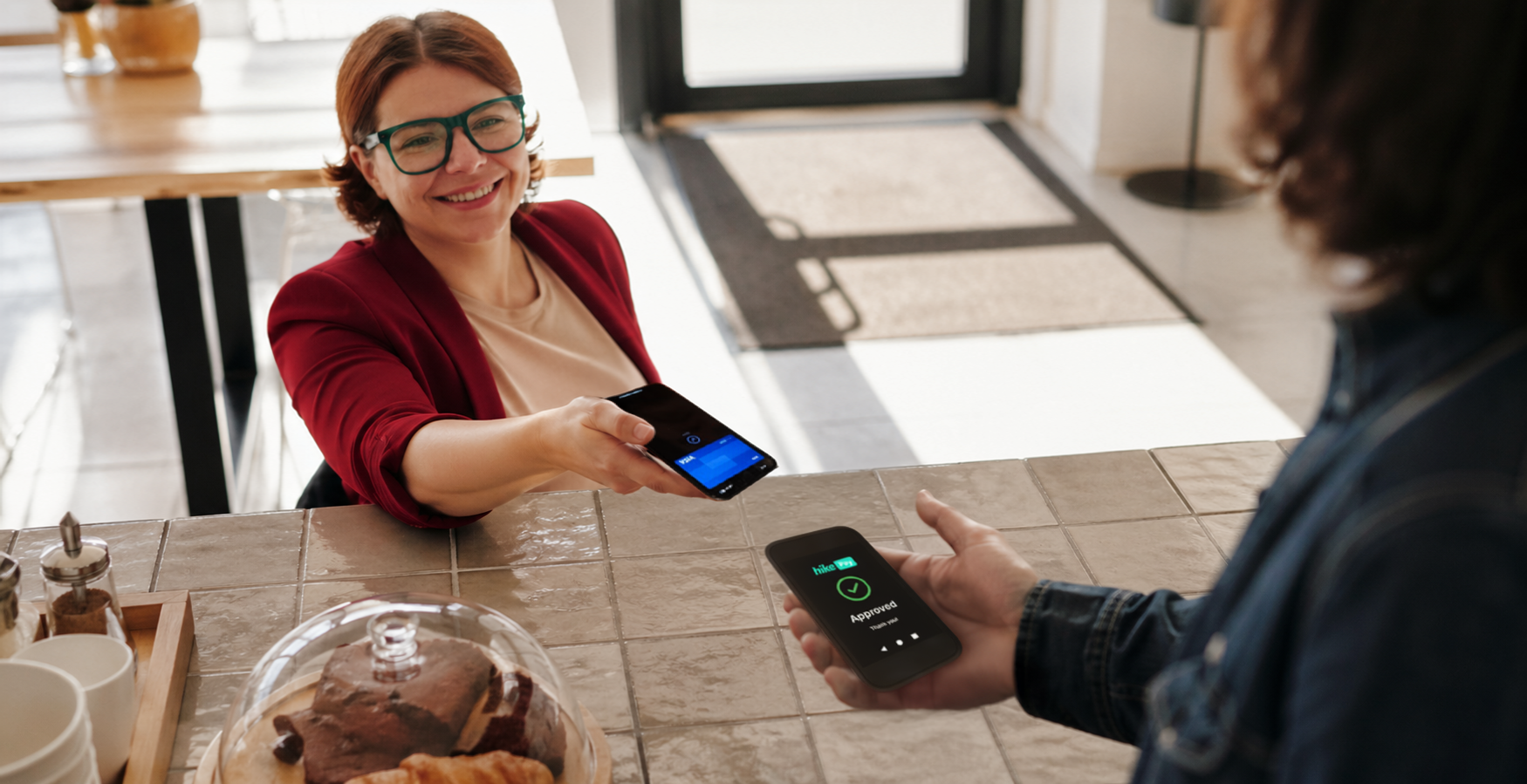
One of the most practical shifts in retail payments is the ability to accept contactless payments directly on a compatible phone or tablet — no separate card terminal required.

This matters in more situations than most retailers realise:

  • Serving customers on the shop floor without sending them to a counter
  • Running pop-up stores, market stalls, or outdoor events
  • Adding a second checkout point during busy periods without extra hardware costs
  • Taking payments tableside in cafes, restaurants, or hospitality settings

A modern POS system with built-in Tap to Pay support turns a compatible device into a payment terminal that accepts contactless cards, Apple Pay, and Google Pay instantly — fast, secure, and no extra hardware needed.

It is not a replacement for a full counter setup in a busy store. But as a flexible option for specific selling moments, it closes gaps that fixed hardware cannot — and customers respond well to being served where they are rather than being sent to queue.

3. Digital Wallets — Apple Pay, Google Pay, Samsung Pay  

Digital wallets are now part of everyday retail behaviour across all major markets — Australia, the UK, the US, Canada, South Africa, and beyond. Many customers, particularly under 40, reach for their phone before their wallet without thinking about it.

Supporting digital wallets is not about adding a feature. It is about aligning with how customers already prefer to pay.

If your payment terminal accepts contactless properly, digital wallets should work at exactly the same speed as a card tap. If they are slower or less reliable, something in your setup needs attention.

4. Debit and EFTPOS Payments  

Debit payments are a core part of retail globally. In Australia, EFTPOS is how a significant proportion of everyday transactions happen — from small independent stores to large retail chains. In the UK and Europe, Visa Debit and Debit Mastercard serve the same role. In the US, debit cards on major networks are a daily standard.

Whatever the local equivalent in your market, customers rely on debit for convenience and spending control. They expect it to work without friction, without extra steps, and without explanation.

This is also where pricing clarity becomes important. Surcharging — where it is permitted — needs to be applied clearly and automatically within your checkout flow. A well-integrated payments setup ensures:

  • Accurate surcharge calculation without manual input from staff
  • Clear visibility for customers on screen before they confirm payment
  • Consistent handling across every transaction type

Handled correctly, customers accept surcharging without issue. Handled poorly — manual calculations, unclear displays, staff having to explain it mid-transaction — it slows checkout and creates hesitation.

5. Buy Now Pay Later — Afterpay, Zip, Klarna and Others 

Buy Now Pay Later has become a genuine purchase decision tool, not just a convenient payment option. Customers use it when they want flexibility without delaying their decision — and for certain product categories, it directly influences whether a purchase happens at all.

Afterpay was founded in Australia and now operates globally. Zip Pay is widely used across AU and NZ. Klarna covers the UK, US, and much of Europe. Across these markets, BNPL is no longer a novelty — it is an expected option for anything above a certain price point.

For the right type of retailer, offering BNPL can:

  • Increase average order value on higher-ticket products
  • Reduce hesitation at checkout when the full price feels like a barrier
  • Improve conversion on items customers want but are not ready to pay for upfront

It is not necessary for every business. A coffee shop does not need Afterpay. But if your products sit in the $100–$500+ range — fashion, homewares, electronics, sporting goods, furniture — not offering BNPL can mean losing sales at the exact moment the customer was ready to say yes.

6. Gift Cards, Store Credit and Loyalty Points  

Customers expect to redeem gift cards, store credit, or loyalty points within the same transaction, at the same counter, without any manual workaround from staff.

When these are managed outside your main checkout system, the process slows down. Staff switch between screens, calculate values manually, or ask customers to wait while they sort it out. None of this is a good look during a busy trading period.

When built natively into your retail POS, these work seamlessly within the checkout flow — applied automatically, tracked accurately, and visible to both staff and customers in real time.

7. Split Payments  

Real transactions are often not as clean as a single tap. A customer wants to put $50 on card and pay the rest in cash. Another wants to use store credit combined with a debit card. These moments happen in most stores every single day.

Your checkout system should handle split payments without it becoming a manual process or a source of stress for staff. A well-built system supports:

  • Card and cash combinations in a single transaction
  • Store credit or loyalty points applied alongside a card payment
  • Partial payments without needing to cancel and restart the checkout

Getting this right keeps checkout moving and reduces the awkward pauses that affect the experience for everyone involved.

8. Cash — Reduced But Not Gone  

Cash usage has declined significantly across most retail markets, but it has not disappeared. Older customers, certain demographics, and specific market contexts still involve cash regularly.

The practical shift is this: cash should no longer be the primary flow your checkout is designed around. Digital payments should be the fastest path. Cash should be available and handled efficiently when needed — without creating a bottleneck for the customers behind.

How Payment Experience Shapes the Customer Experience  

Customers rarely think consciously about payment methods — but they absolutely notice how checkout feels.

A fast and predictable checkout builds confidence. Customers move through quickly, nothing needs explaining, and staff are not under pressure to apologise or troubleshoot. The whole interaction ends on a good note.

A poor payment experience does the opposite. A failed tap, an unclear surcharge, a slow system, or a method you do not support — any of these creates a moment of friction that colours how the customer remembers the visit. They may not tell you about it. But they notice.

A strong payment experience consistently delivers:

  • A checkout that feels effortless and expected
  • Reduced confusion for both staff and customers
  • Predictable, repeatable results across every transaction
  • A final impression that reinforces rather than undermines the rest of the visit

These moments feel small. Over time, they add up to how your store is perceived.

How Payment Speed Directly Impacts Sales  

Payment speed is not just an operational consideration — it directly affects your revenue.

Customers do not always abandon a purchase because of price. They abandon it because checkout felt slow, inconvenient, or uncertain. Long queues during peak hours push people to leave before they reach the counter. A clunky payment process at the end of a good shopping experience can undo everything that came before it.

Even small delays per transaction compound quickly. If checkout takes ten seconds longer than it should, that adds up to significant lost capacity across a busy trading day.

A faster, more reliable checkout helps:

  • Increase the number of completed transactions during busy periods
  • Keep queues moving so customers do not leave before paying
  • Reduce pressure on staff and improve their ability to serve customers well
  • Create a closing moment that reinforces the overall experience

Retailers spend a great deal of time and money getting customers into the store. Checkout is the last thing that determines whether they leave having bought something.

What Makes a Retail Checkout Fast and Efficient  

Speed Under Real Conditions  

A system that works during quiet hours is not the benchmark. The benchmark is how it performs on your busiest day of the year, during your busiest hour, with a queue of customers and staff under pressure.

When your POS system and payments are fully connected, transactions move in a continuous flow — sale processed, payment taken, receipt issued, next customer. When they are running as separate systems, small delays build up quickly and visibly.

Reliability and Offline Capability  

Network issues happen in every retail environment. A router drops, a building has patchy signal, a market location has no reliable Wi-Fi. If your entire payment setup depends on a live internet connection, your store stops taking sales when the connection drops.

A reliable system continues processing transactions during temporary outages and syncs data automatically when connectivity returns. This is easy to overlook until it happens to you during a peak trading period — and then it becomes the only thing that matters.

Consistency Across Locations  

For retailers running more than one store, consistency is critical. Customers who shop across your locations expect the same checkout experience everywhere — same payment options, same speed, same overall feel.

If one location accepts Apple Pay and another does not, or one terminal is faster than another, it creates an uneven experience that reflects poorly on the brand. A centralised all-in-one POS system  ensures consistent configuration, speed, and reporting across every location.

Online and In-Store Alignment  

Customers move between channels without thinking about it. They browse online, check stock, and complete the purchase in store. Or they buy in store and return online. They do not see these as separate experiences — they see them as one relationship with your business.

If your payment options differ across channels, or your pricing is inconsistent between online and in store, it creates confusion. A connected eCommerce and POS setup keeps payments, inventory, and reporting aligned across both environments so customers always get the same experience.

Payment Costs Retailers Often Overlook  

Payments are one of the areas where costs are easiest to ignore — because they arrive as small percentages, monthly line items, and fee structures that do not demand attention until they add up.

Transaction Fees  

Every payment method carries a processing cost. Card rates vary by provider, card type, and transaction volume. BNPL providers typically charge the retailer a higher percentage per transaction than standard card rates. Digital wallet transactions may carry their own rates depending on your setup.

None of these are necessarily unreasonable, but they affect your margins on every single sale. Knowing exactly what you are paying per payment type — and whether those rates are competitive for your transaction volume — is basic financial hygiene for any retail business.

Monthly Platform and Terminal Fees  

Some payment providers charge monthly terminal rental fees, platform access fees, or account keeping fees on top of their transaction rates. These ongoing costs can make a seemingly competitive transaction rate significantly more expensive in practice.

It is worth calculating your total monthly cost across all fees — not just the per-transaction rate — and comparing that against what modern providers now offer. $0 terminal fees and $0 monthly platform fees are available from providers like HikePay, Hike’s built-in payments solution. If you are currently paying monthly fees on top of transaction rates, the total cost may not be working in your favour.

Settlement Times  

 How quickly funds reach your bank account matters more than most retailers realise until cash flow becomes tight. Some providers settle in one to three business days. Others offer same-day settlement.

During busy trading periods — a big sale, a peak season, a product launch — having funds available quickly to restock or cover operating costs can make a real difference. Settlement time is rarely the first question retailers ask when choosing a payment provider. It often becomes the most relevant one once they are up and running.

Surcharging Rules by Region  

Surcharging regulations vary significantly across markets and getting this wrong creates both compliance risk and a poor customer experience.

  • Australia — retailers can pass transaction costs to the customer, but only up to the actual cost of acceptance. The surcharge must be displayed clearly before the customer confirms payment. This is standard practice in AU retail and customers generally accept it when handled transparently
  • UK and EU — surcharging on consumer credit and debit cards is generally prohibited under payment regulations. Retailers absorb transaction fees rather than passing them on
  • US — rules vary by state. Surcharging on credit cards is permitted in most states but prohibited on debit cards in many. Disclosure requirements also vary by state

If you operate across multiple markets or are planning to expand, understanding the rules in each region is important — both for compliance and for accurately calculating your true cost per transaction.

How to Evaluate Your Current Payment Setup  

Your payment setup is working well if most of these are true:

  • Checkout moves at the same speed at peak hours as during quiet periods
  • Staff never have to apologise for a payment method not being supported
  • Surcharges, where used, are applied automatically without manual input
  • Reconciliation at end of day is automatic and takes minutes rather than an hour
  • Payment data — by type, by location, by period — is visible in one place
  • Monthly costs are transparent, predictable, and competitive
  • Funds settle quickly enough to support your cash flow needs
  • BNPL is available if your product range and average order value warrants it
  • Tap to Pay on a device is available for situations where a fixed terminal is not ideal
  • Your in-store and online payment experience is consistent

If several of these feel uncertain, your current setup may be costing you more than you realise — in fees, in time, or in customer experience that is quietly below where it should be.

Quick Checklist: Is Your Payment Setup Ready for 2026?  

Requirements vary slightly by business type — a cafe focuses on speed, a multi-location retailer prioritises consistency, a fashion store needs BNPL. But these core questions apply across the board:

  • Do you accept contactless payments and digital wallets reliably?
  • Is checkout consistently fast during your busiest hours?
  • Are surcharges applied automatically if you use them?
  • Can you accept payments anywhere in store, not just at a fixed counter?
  • Does your system handle split payments without manual workarounds?
  • Are payments and POS fully connected in one system?
  • Do you know your total monthly payment costs — not just the transaction rate?
  • Are your in-store and online payment experiences aligned?

The Bottom Line  

Customers already know how they want to pay. Your job is simply to make sure nothing at checkout slows them down.

That means having the right payment methods in place, supported by hardware that performs under pressure, connected to a system that keeps everything accurate behind the scenes — with costs that are transparent and settlement that supports your cash flow.

When that is all working, checkout becomes invisible. And invisible is exactly what good checkout should feel like.

Explore how Hike connects payments, POS, and eCommerce in one system — or start your free trial today.

Get started today

Ready to get started with Hike?

Try Hike free for 14 days. Instant access, no credit card, no risk.

  • 14-day free trial
  • No credit card
  • Cancel anytime